You turn over a packet of food and start reading the ingredients.
Flour. Sugar. Oil.
So far, so good.
Then suddenly you’re looking at emulsifiers, stabilisers, preservatives and a collection of numbers that look more like something from a chemistry textbook than a food label.
What exactly are all those numbers? And should you be worried about them?
The short answer is that they’re food additive numbers. And while some of the names can sound intimidating, the numbers themselves are simply a way of identifying particular additives.
Here’s what they actually mean.
What is a food additive?
A food additive is a substance added to food for a particular purpose.
They can be used to help food last longer, maintain its texture, add or restore colour, improve consistency or perform a number of other functions.
Some common types include:
Preservatives
Colours
Emulsifiers
Stabilisers
Thickeners
Sweeteners
Acidity regulators
Antioxidants
If you eat packaged food, you’ve almost certainly eaten food additives.
That doesn’t automatically make the food “bad”. The more useful question is what additive is being used, why is it there, and what does the rest of the product look like?
So, what do the numbers mean?
In Australia and New Zealand, approved food additives may appear in an ingredients list using their name or identifying number.
For example, instead of seeing the full name of an additive, you might see something like:
Preservative (202)
or
Thickener (415)
The number is essentially an identification system. It gives a particular additive a standardised code so it can be recognised without writing out its full chemical name every time.
And this is where another common question comes in.
Are additive numbers the same as E numbers?
You may have heard people refer to E numbers, particularly in information coming from Europe.
The systems are closely related, but the “E” refers to additives approved for use in the European Union.
On Australian and New Zealand food labels, you’ll commonly see the number without the E.
So if you’ve seen “E330” online and “330” on a packet here, they can refer to the same additive.
Does a number mean an ingredient is artificial?
No.
This is one of the biggest misconceptions about additive numbers.
Seeing a number in an ingredients list doesn’t automatically mean you’ve found a mysterious artificial chemical.
Some additives can come from naturally occurring sources, while others are manufactured.
The number itself simply identifies the additive.
For example, 300 is ascorbic acid, otherwise known as vitamin C. It can be used as an antioxidant in food.
That’s why judging an ingredient purely because it has a number beside it doesn’t tell you very much.
Are food additives safe?
Food additives permitted for use in Australia and New Zealand are regulated by Food Standards Australia New Zealand (FSANZ).
Before an additive can be permitted for use, FSANZ assesses its safety and determines the conditions under which it can be used.
That doesn’t mean you have to ignore additives when deciding what to buy.
Some people may choose to eat fewer highly processed foods. Others may be interested in particular additives or want to understand why they’re present.
The important thing is having useful information rather than assuming every additive is dangerous, or that every additive is something you need to avoid.
Why do some foods have so many additives?
This is where things get more interesting.
A simple food might need very little processing.
But some packaged foods need to maintain a particular flavour, colour, texture or shelf life for weeks or months.
Manufacturers might use emulsifiers to keep ingredients mixed together, preservatives to slow spoilage, colours to change or restore appearance, or thickeners and stabilisers to create a particular texture.
That’s one reason an ingredients list can tell you more than the marketing on the front of the packet.
Two products that look almost identical on the shelf can have very different ingredient lists.
Does more additives mean a food is unhealthy?
Not necessarily.
Nutrition isn’t that simple.
Counting additives alone won’t tell you everything you need to know about a food.
A product could have very few additives but still be high in sugar, salt or saturated fat. Another could contain an additive for a perfectly practical reason while having an otherwise relatively simple nutritional profile.
It’s better to look at the whole product.
Consider the ingredients, nutrition information and degree of processing together rather than judging a food from one number.
Why is this so difficult at the supermarket?
Because nobody wants to Google “additive 322” while standing in aisle seven.
And then repeat the process for another five ingredients.
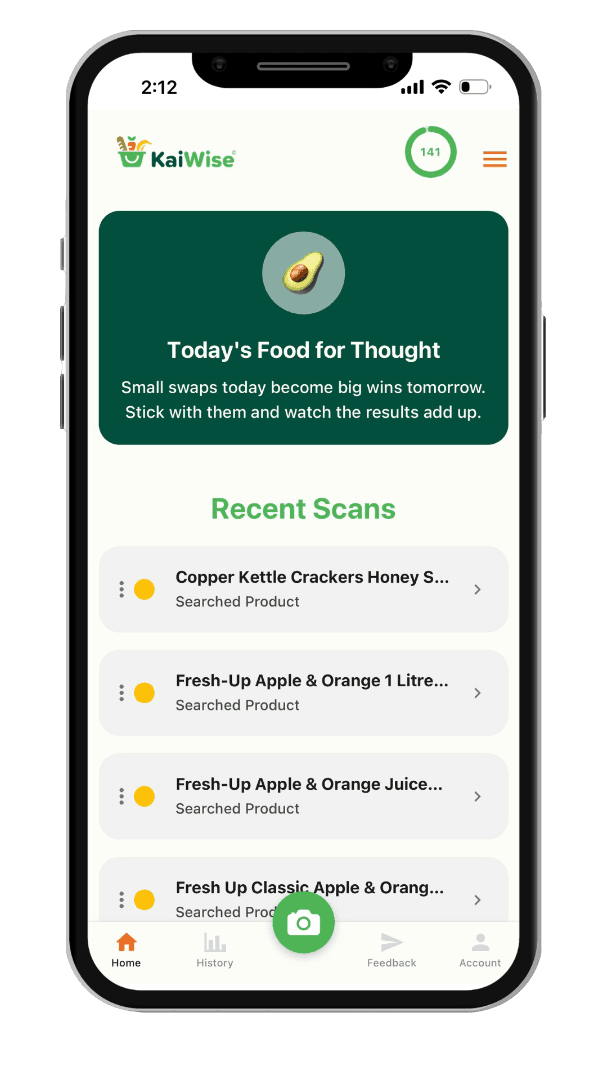
That’s a big part of why we built KaiWise.
Scan the barcode on a packaged food and KaiWise helps translate the information on the packet into something much easier to understand.
Instead of trying to memorise additive numbers, you can see what the additives are and explore more information about what’s in the product.
KaiWise also looks beyond additives, including things like sugar, salt, saturated fat, fibre, protein and the level of processing, so you can see a broader picture of the food you’re considering.
You don’t need to memorise every number
That’s probably the biggest takeaway.
Understanding food additives shouldn’t mean learning hundreds of codes by heart.
Knowing that the numbers identify specific additives, and understanding why additives are used, is a great place to start.
From there, you can decide how much detail matters to you.
We’re not interested in making people frightened of what’s in their food.
We’d rather make it easier to understand.
And next time you’re staring at an ingredients list wondering what on earth all those numbers mean, you can always let KaiWise do the translating for you.