September 8, 2026


Food labels can feel overwhelming, but understanding them doesn’t have to be complicated. This simple guide breaks down ingredients lists, nutrition panels, additives and food claims to help NZ and Australian shoppers make more informed choices at the supermarket.
You pick up a product at the supermarket and turn it around.
There’s a tiny ingredients list, a table full of numbers, a few unfamiliar ingredient names and perhaps a claim on the front telling you it’s “natural”, “high protein” or “low fat”.
So… is it actually a good choice?
Food labels contain a lot of useful information, but knowing what to look for isn’t always obvious. And when you’re doing the weekly shop, possibly with kids in tow and dinner still to make, you probably don’t have ten minutes to analyse every packet you pick up.
The good news is you don’t need to be a nutrition expert to get more confident with food labels.
Here are a few simple things worth knowing.
1. Start with the ingredients list
The ingredients list tells you what has actually gone into a product.
In New Zealand and Australia, ingredients are generally listed in descending order by weight. That means the first few ingredients usually make up the largest proportion of the food.
So rather than trying to decipher every single word, start by looking at what comes first.
You might also notice that some ingredients have several different names. Sugar, for example, can appear as glucose, fructose, sucrose, dextrose, syrups and other forms.
Then there are the numbers.
What are those numbers in the ingredients list?
Numbers such as 440 or 202 are food additive identification numbers.
Additives can be used for many different reasons, including preserving food, adding colour, changing texture or maintaining consistency.
Seeing an additive doesn’t automatically tell you whether a food is “good” or “bad”. What matters is understanding what the ingredient is, why it’s there and having enough information to make a choice you’re comfortable with.
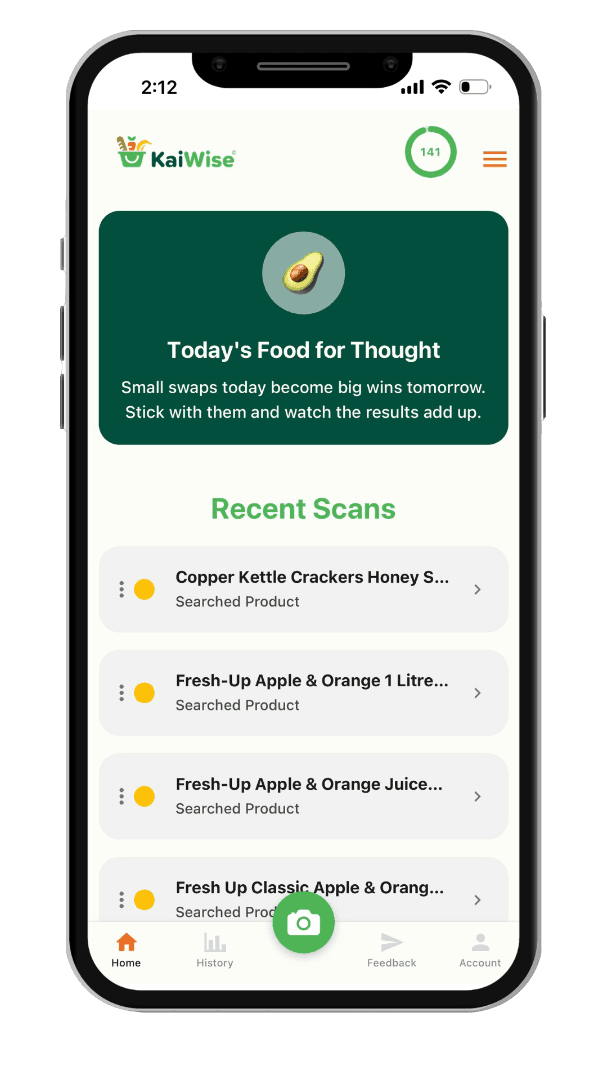
That’s one of the reasons we created KaiWise. Instead of expecting you to remember hundreds of ingredient names and numbers, you can scan a product and get a much simpler explanation of what’s inside.
2. Check the nutrition information panel
Next is the table of numbers on the back of the packet, officially called the Nutrition Information Panel (NIP).
It usually includes:
Energy
Protein
Fat
Saturated fat
Carbohydrate
Sugars
Sodium
You’ll normally see values listed both per serving and per 100 g (or 100 mL for liquids).
Per serve or per 100 g: which should you use?
If you’re comparing two similar products, the per 100 g column is usually the easiest place to start.
Why?
Because serving sizes can differ between brands.
One cereal might call 30 g a serving while another uses 45 g. Looking at the values per 100 g gives you a more consistent way to compare the two.
Just remember to compare like with like. Comparing two breakfast cereals makes sense. Comparing breakfast cereal with yoghurt doesn’t tell you much because they’re completely different foods.
3. Pay attention to sugar, sodium and saturated fat
There isn’t one number on a nutrition panel that tells you the whole story.
But sugar, sodium and saturated fat are three useful things to look at when comparing similar packaged foods.
Rather than getting caught up trying to decide whether an individual number is “good” or “bad”, try comparing the options in front of you.
If two products are very similar, does one contain considerably less sodium? Does another contain much more sugar?
Sometimes a small comparison can make the decision much easier.
4. Don’t let the front of the packet make the decision for you
This is an important one.
“Natural.”
“No added sugar.”
“High protein.”
“Made with whole grains.”
“Low fat.”
These claims can give you useful information, but they don’t necessarily tell you the full nutritional story of the product.
A product can meet the requirements for a particular nutrition claim while still containing other ingredients or nutrients you may want to know about.
So think of the front of the packet as the introduction.
The back is where you get the detail.
5. Look at the food as a whole
One of the easiest traps to fall into with nutrition is focusing on a single ingredient.
A product isn’t automatically unhealthy because it contains one unfamiliar ingredient, just as it isn’t automatically healthy because it contains something nutritious.
Food is more complicated than that.
That’s why it’s useful to look at the bigger picture: the ingredients, nutritional profile and how that food fits into the way you and your whānau eat overall.
And sometimes, the option you choose doesn’t need to be perfect.
It just needs to be the better choice for you.
Making food labels simpler
We created KaiWise because we know most people don’t want to stand in the supermarket researching ingredients.
They just want a clear answer to a simple question:
What’s actually in this food?
With KaiWise, you can scan the barcode of a packaged food and see its information presented in a way that’s much easier to understand.
Our traffic light system helps simplify the information, while you can dig deeper into ingredients, additives and nutritional information when you want to learn more.
You can also compare products, making it easier to decide between similar options on the shelf.
The goal isn’t to make you scared of food or tell you that you have to eat perfectly.
It’s to give you better information, so you can make your own decisions with confidence.
Because understanding what’s in your food shouldn’t require a nutrition degree.
Want an easier way to understand what’s in your trolley?
Download KaiWise and scan your next supermarket shop.
Blogs
Read other blogs
AI-powered algorithm to recommend the best job opportunities, saving you time and effort.